
Why Your Brain Forgets Everything (And How to Fix It)

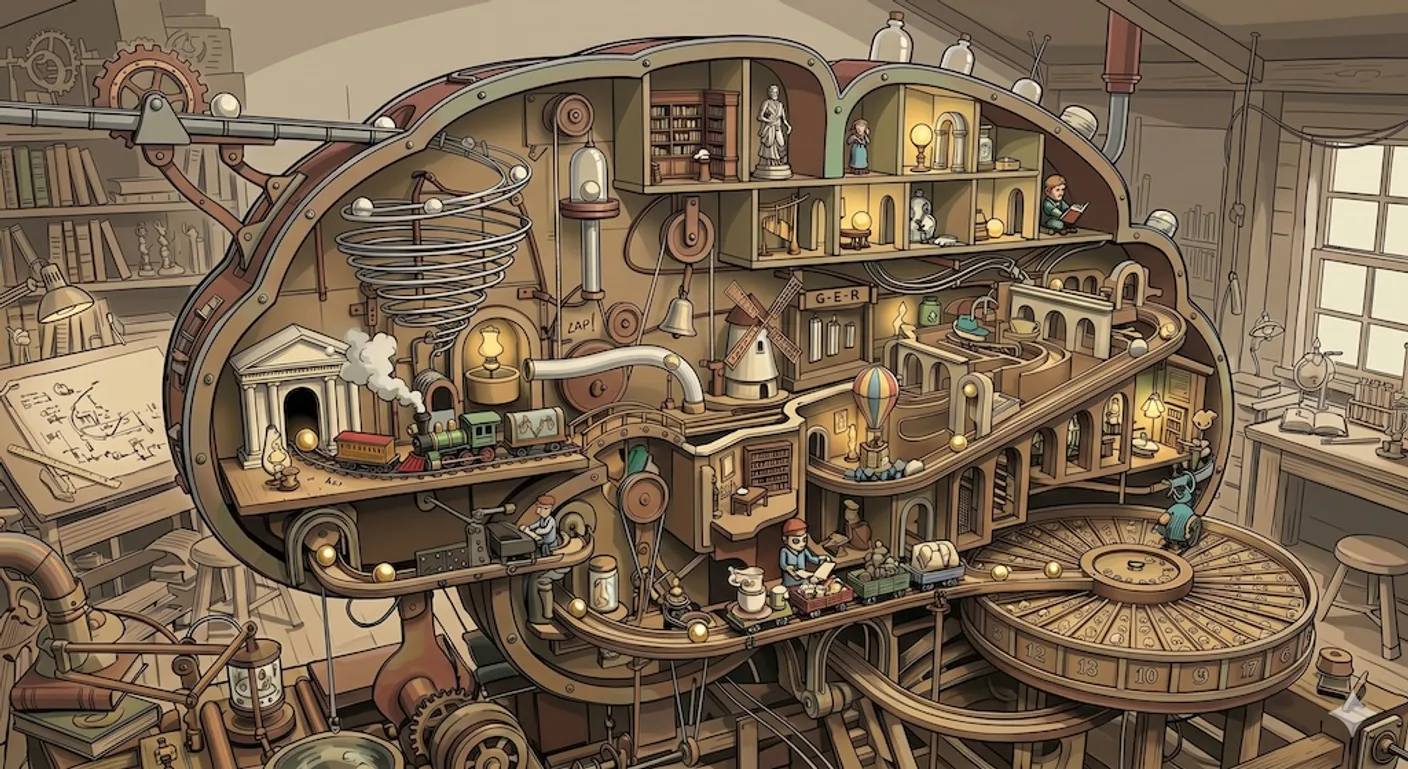
Why Your Brain Forgets Everything (And How to Fix It)
Let’s start with an uncomfortable truth: your brain is actively working against you.
Right now, your brain is running a sophisticated garbage collection system, deciding most information belongs in the trash. That podcast you listened to yesterday? Gone. The capital of Kyrgyzstan? Never stood a chance.
This isn’t a bug. It’s a feature. Your brain evolved to remember which berries were poisonous, not Central Asian geography. The problem is you’re trying to use stone-age hardware to run modern software.
But researchers have spent decades figuring out how to hack this system. Here are six that actually work.
Dual Coding
Your brain processes words and images through completely separate channels. Most education ignores this - it’s all text, all the time.
But when you combine words AND images for the same concept, you get two separate memory traces pointing to the same information. Redundancy. Backup systems.
This is why you remember what Italy looks like (boot!) but not its GDP. One gave your visual brain something to grab onto.
Takeaway: Find a way to visualize what you’re learning. Draw it. Map it.
Spaced Repetition
You know that thing where you cram for an exam, pass it, and forget everything within 72 hours? That’s completely normal.
The pattern: Learn something, review after 1 day, then 3 days, then 7, then 14, with increasing gaps. Students using this retain information for months longer than crammers.
Takeaway: Stop marathoning your study sessions. Space them out.
Interleaving
Traditional studying says focus on one thing until you master it. Practice all addition, then subtraction, then multiplication.
This feels productive. It’s also worse than mixing topics within the same session. When everything is sorted, your brain goes on autopilot. When topics are mixed, your brain has to actually think.
Physics students who interleaved improved by 125% compared to those who practiced in blocks.
Takeaway: Mix it up. If it feels too easy, you’re not learning as much as you think.
Contextual Memory
Your brain bundles memories with the context where they formed - the smell, location, music, emotional state.
This is why you forget why you walked into the kitchen, but remember when you go back to the living room. It’s also why learning geography by spinning a globe works - the physical interaction becomes part of the memory.
Takeaway: Create memorable contexts. Stories, scenarios, physical locations.
Microlearning
That feeling when you study for three hours and by minute 45 you’re just staring at words while your brain plays elevator music? That’s biology, not weakness.
Short, focused sessions consistently outperform marathon study sessions. Your brain needs breaks to consolidate what it’s learned.
Takeaway: Twenty minutes of focus beats two hours of suffering.
The Memory Palace
The ancient Greeks figured out that humans are really good at remembering places. The memory palace exploits this: imagine a place you know well and mentally place things you want to remember in specific locations.
Want to remember European countries west to east? Portugal is on your doormat. Spain in the entryway. France in the living room.
90% of memory champions use this. It works.
Takeaway: Turn abstract information into a mental journey.
The Bottom Line
The way most people learn - cramming, rereading, highlighting - feels productive but mostly creates the illusion of learning.
The techniques that work often feel harder. That’s because they force your brain to actually work.
Your brain isn’t broken. It’s just running on ancient firmware. Now you know the workarounds.
We built JordGlobe with these techniques in mind - visual learning on an interactive globe, spaced repetition to bring back what you’re forgetting, and bite-sized sessions that actually stick.